
Understanding the Role of Managers in IFS (Internal Family Systems)
The part of you that plans three steps ahead. The voice that tells you your work is not quite good enough yet. The part that keeps everyone else happy, avoids conflict, stays productive, or thinks through every possible outcome before making a decision.
In Internal Family Systems therapy, or IFS, these patterns may be understood as manager parts.
Managers are not necessarily a problem. They often help us stay organized, responsible, prepared, and connected to others. But when a manager feels as though it can never stop working, a strategy that was meant to protect us can also leave us anxious, exhausted, or disconnected from what we actually need.
One of the things I appreciate about IFS is that it gives us a different way of approaching these patterns. Instead of immediately asking, “How do I stop doing this?” we can begin with a more curious question:
What is this part of me trying to prevent?
Where Managers Fit in the IFS Model
IFS understands the mind as containing different “parts,” each with its own feelings, beliefs, memories, and ways of responding.
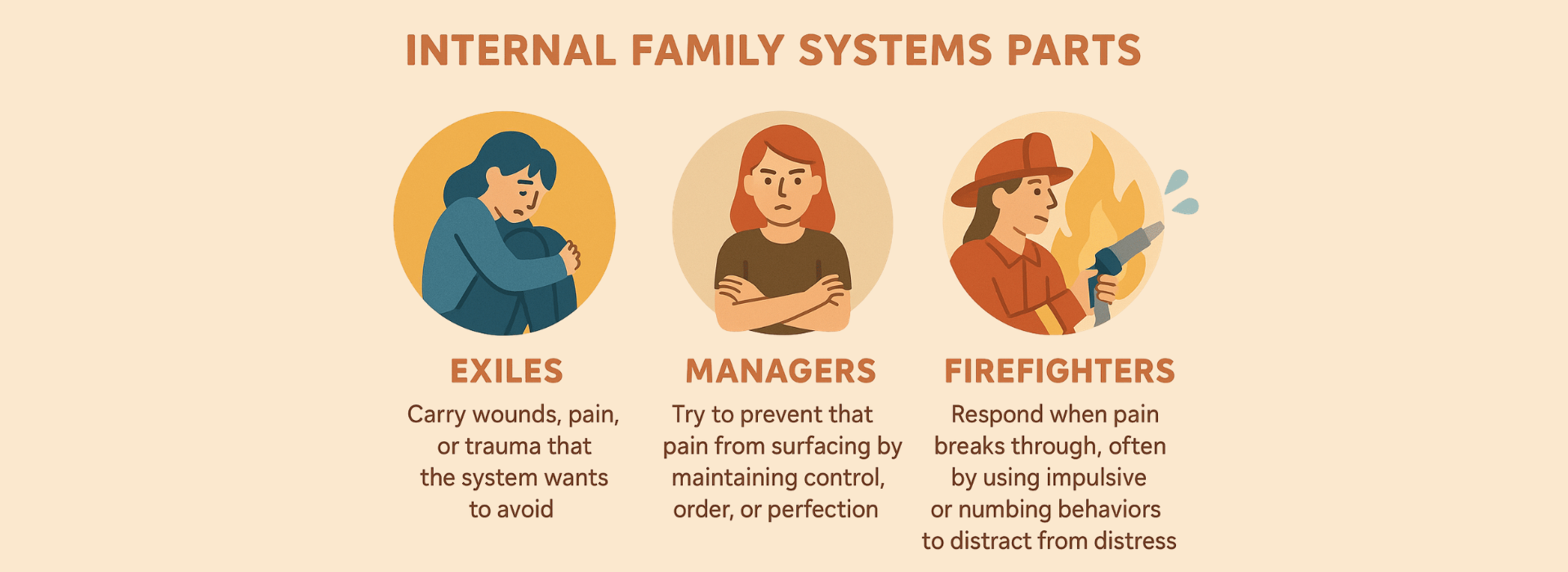
According to IFS, every person has:
Exiles, which carry wounds, pain, or trauma that the system wants to avoid
Managers, which try to prevent that pain from surfacing by maintaining control, order, or perfection
Firefighters, which respond when pain breaks through, often by using impulsive or numbing behaviors to distract from distress
Managers are considered proactive protectors. Their job is to anticipate problems and keep things under control before vulnerable feelings have a chance to surface.
A manager may believe that everything needs to be done correctly, that other people cannot be disappointed, that uncertainty needs to be eliminated, or that staying busy is the safest option. It might tell you that you need to think through every possibility before acting, that you cannot let yourself fail, or that you should be able to handle things without needing anyone else.
From an IFS perspective, the goal is not to criticize these parts. It is to understand why they believe their job is necessary.
What Do Manager Parts Look Like?
Managers can show up in many different ways.
A perfectionistic part may believe mistakes lead to criticism, rejection, or failure. It may push you to work longer than necessary, revise things repeatedly, or avoid starting because the result might not be good enough.
An inner critic may judge you before anyone else gets the chance. The criticism can feel harsh, but underneath it there may be an attempt to protect you: If I point out every flaw first, maybe nobody else can surprise me with it.
A planning part may try to anticipate every possible problem before you can relax. Planning itself is useful, but when a manager believes it must guarantee certainty, it can lead to constant research, rehearsing conversations, or difficulty making decisions.
A people-pleasing part may closely monitor what everyone else needs or expects. It may have learned that harmony creates safety, making it difficult to say no, set boundaries, or even recognize what you want yourself.
Managers can also show up through achievement, caretaking, self-reliance, or intellectualizing. The behavior differs, but the underlying belief is often similar: if I stop doing my job, something painful may happen.
Why Do Manager Parts Develop?
Manager parts usually make sense in the context in which their strategies developed.
If mistakes were heavily criticized, a perfectionistic part may have learned, If I never make mistakes, I will be safe.
If relationships felt unpredictable, another part may have learned to monitor other people's moods: If I can tell what everyone is feeling, maybe I can prevent something bad from happening.
If expressing emotion led to conflict or rejection, a manager may have decided that staying controlled and handling things alone was the safest approach.
These strategies may have been incredibly effective at one point in your life. The difficulty is that parts do not always recognize when circumstances have changed. A strategy that protected you years ago may continue operating even when you now have more choices, resources, and support.
Managers and Firefighters
Managers and firefighters are both protective parts, but they tend to work at different moments.
Managers try to prevent distress before it happens. Firefighters tend to respond once painful feelings have already broken through.
For example, a manager might insist that you prepare obsessively for an important presentation so you cannot be embarrassed. If something goes badly anyway, a firefighter might push you to withdraw, distract yourself, numb out, or avoid thinking about what happened.
Both are attempting to protect vulnerable parts of the system. They simply use different strategies.
Sometimes this can create an internal tug-of-war: one part demands more discipline and control, while another desperately wants relief.
What Are Managers Protecting?
In IFS, managers often work to prevent contact with more vulnerable parts, or exiles, that carry experiences of fear, shame, grief, loneliness, rejection, or inadequacy.
A manager may believe that if those feelings become fully accessible, they will be overwhelming. So it works constantly to keep them contained.
This is why simply telling an anxious, perfectionistic, critical, or controlling part to “relax” often does not work. From that part's perspective, relaxing may feel unsafe.
A more useful question can be:
What does this part believe would happen if it stopped?
Beneath a critical voice may be fear of rejection. Beneath constant productivity may be fear of not being good enough. Beneath people-pleasing may be a fear that conflict will threaten a relationship.
When we understand what the manager is protecting, the pattern often begins to make more sense.
The Goal Is Not to Get Rid of Your Managers
The goal of IFS is not to eliminate the planner, critic, achiever, caretaker, or other protective parts.
These parts often carry qualities we genuinely value. A perfectionistic part may have strong attention to detail. A caretaker may be compassionate and perceptive. A planner may be organized and thoughtful.
The difficulty comes when a part believes it has to perform its job constantly or at an extreme level.
IFS therapy helps us develop a different relationship with these parts. Instead of fighting them, we become curious about what they are trying to accomplish, what they fear would happen if they stopped, and what they might need in order to give us a little more space.
Understanding a part does not mean allowing every protective strategy to continue unchanged. It means creating the possibility of change without going to war with yourself first.
Internal Family Systems Therapy in Portland, Maine
Managers are only one part of the Internal Family Systems model, but they can offer a useful way of understanding anxiety, perfectionism, self-criticism, people-pleasing, burnout, and relationship patterns.
I use Internal Family Systems as one of the primary approaches in my work with adolescents and adults in Portland, Maine.
If you recognize some of these patterns in yourself, you do not need to identify all of your parts or understand exactly where they came from before beginning therapy. We can start with whatever feels most present.
The goal is not to get rid of parts of you. It is to understand what they have been trying to do for you and help you develop more freedom in how you respond.
If you are interested in learning more, you can explore my Internal Family Systems Therapy page or contact me to schedule an initial consultation.